


The core logic of process control can be easily understood through the principles of baking. Both rely on precise parameter control and stable output to achieve the desired results.
In baking, ingredient ratios must be accurate and the heat supply must remain stable. The oven's temperature controller continuously collects temperature data and transmits it to the controller, which then activates or deactivates the heating element based on the temperature deviation, ensuring that the oven temperature always meets the required setpoint.
In the process industry, the equivalent of a baking "recipe" is the clearly defined standards for key process parameters such as tank level and pipeline flow rate. To stabilize these parameters, sensors collect real-time data and transmit it to the controller, which then precisely adjusts the control valve opening, forming a closed-loop control of the process parameters.
In general, all control systems operate based on three core steps:
- Parameter measurement: Real-time acquisition of key process parameters such as temperature, pressure, and flow rate;
- Value comparison: Comparing the measured value with the preset target value (i.e., the setpoint) to determine whether a deviation exists;
- System adjustment: If a deviation exists between the measured value and the setpoint, adjustment actions are immediately performed (such as opening or closing the control valve, or adjusting its opening).
To achieve precise control, the response speed and accuracy of each step cannot be overlooked. This article focuses on the third step-bringing process parameters back to the setpoint by adjusting the control valve-and discusses how auxiliary devices can be used to improve the efficiency and accuracy of this step.
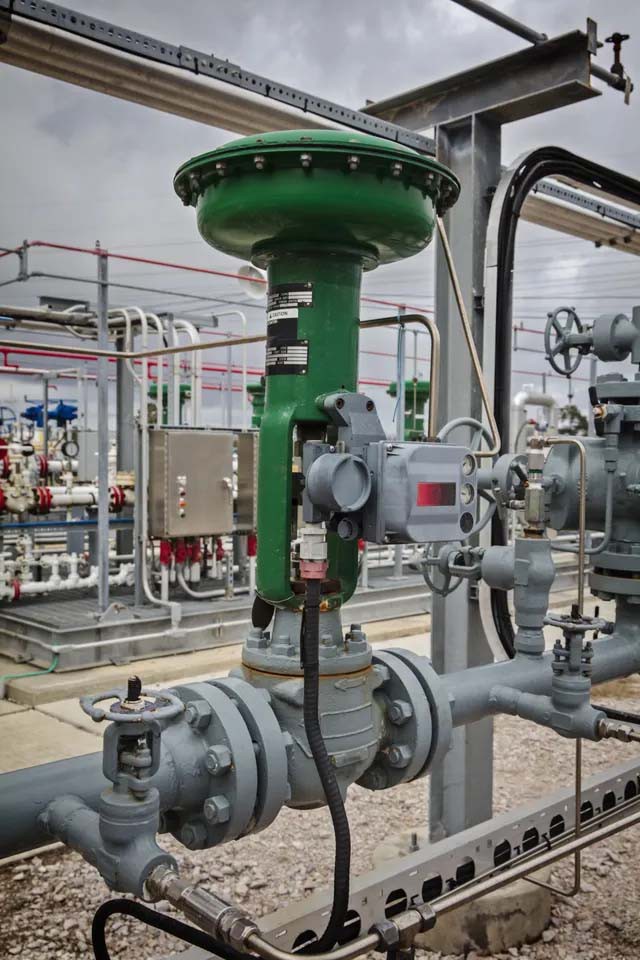
What Is a Valve Positioner?
In a standard control system, the process controller sends control signals directly to the actuator, which then drives the control valve. This approach can meet basic control requirements, but the response is relatively slow, and inherent deviations in the actuator limit control accuracy, making it unsuitable for high-precision applications.
For operating conditions with frequent fluctuations and high demands on control accuracy, an additional dedicated device-such as a Fisher valve positioner-is required to ensure fast and precise system response.
As a key component connecting the process controller and the actuator, the valve positioner is linked to the valve stem and can monitor the actual valve opening in real time. Its operating principle is straightforward: it receives the signal from the controller, calibrates it based on the measured valve position, and then outputs a precise driving signal to the actuator, thereby achieving accurate control of the valve opening.
Five Core Advantages of Control Valves Equipped with Positioners
Valve positioners are not required in every application, but they play a critical role in key operating conditions where parameter fluctuations affect production efficiency and product quality. Their main advantages include:
- Improved Control Accuracy: By continuously monitoring valve position and applying feedback correction, advanced digital solutions such as the Fisher valve positioner achieve significantly higher control accuracy than actuators alone.
- Faster Response Speed: Through precise signal calibration and driving, control valves can respond quickly to process parameter fluctuations, minimizing the duration of deviation from the setpoint and improving overall control efficiency.
- Stable Valve Opening: Positioners effectively compensate for fluctuations in pressure differential across the valve, maintaining stable valve positioning. Pressure differential fluctuations often indicate an unstable control loop; the positioner dynamically balances these effects to ensure normal loop operation.
- Enhanced Configuration Flexibility: With a positioner installed, the installation distance between the controller and the control valve becomes more flexible. Positioners are compatible with both diaphragm and piston actuators, support switching between direct-acting and reverse-acting modes, allow adjustment of valve flow characteristics based on operating conditions, and even enable split-range control in which a single controller drives two valves.
- Reduced Negative Impact of Friction: Friction from valve stem packing can introduce hysteresis and deadband into the system, reducing control accuracy and production efficiency. Positioners minimize these adverse effects through precise signal compensation.
In addition to the advantages above, the actual performance of a valve positioner depends on specific operating conditions and system configuration. Selecting the appropriate positioner for the application is key to maximizing its benefits.


